
Peer Light • Faith Brown
This is a part of our Peer Light conversation series, curated by Slow Blink for Center for Independence in 2026. Below, find the conversation between Bretty of Slow Blink and Faith Brown, Executive Director of CFI. See Faith’s full bio at the bottom of the page.
***
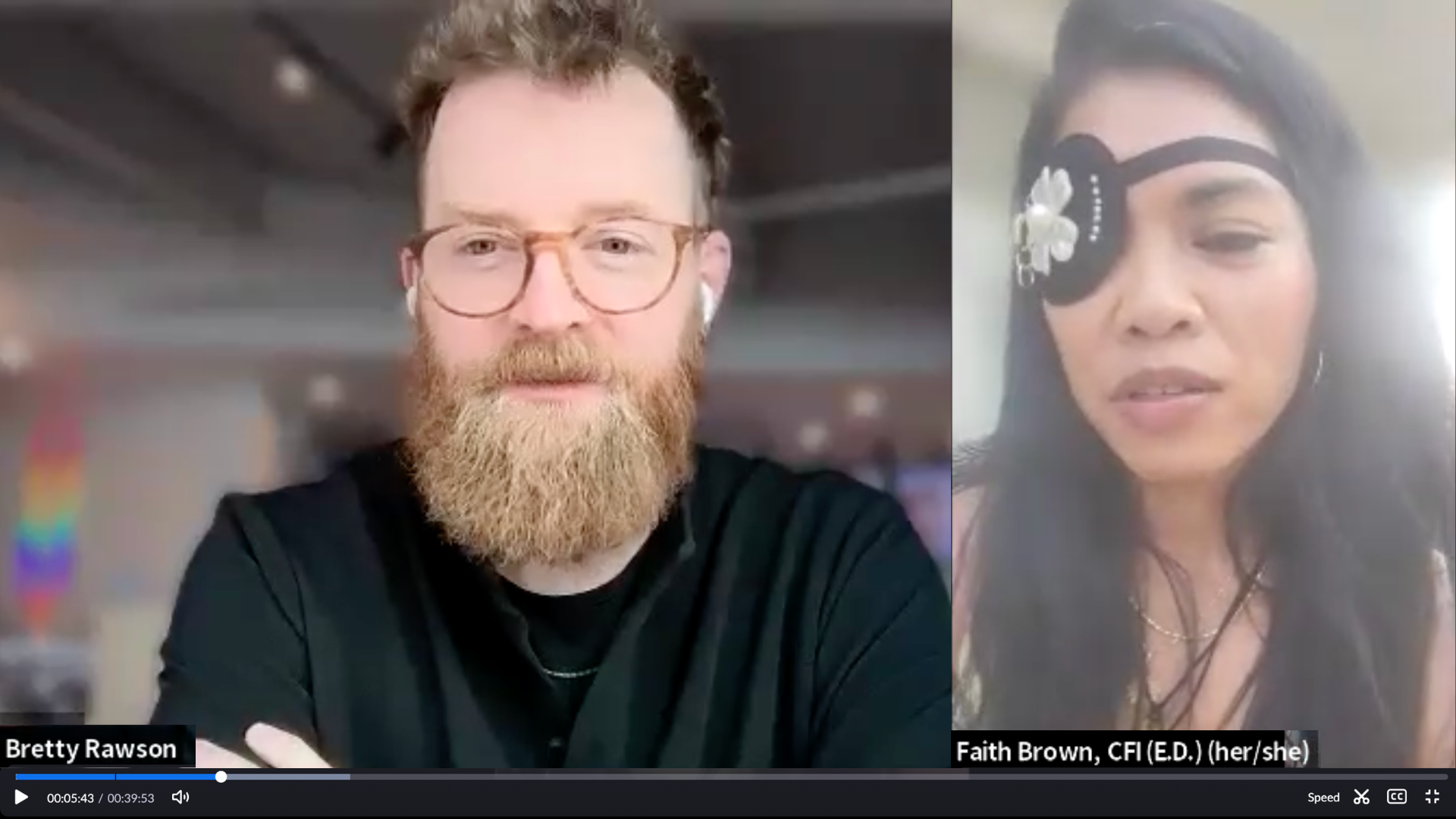
Bretty and Faith during their Zoom call together.
Slow Blink: What’s your role at CFI?
Faith Brown: My name is Faith Brown and I am the Executive Director for Center for Independence. I've been serving since November 2024. On a daily basis, it means that we are serving the community and that we are serving the mission through the community. It's wonderful because we're part of this huge national network and this movement, consolidated and moving in solidarity.
A lot of the day is making sure that that engine is oiled and running and that it is just moving at the pace of the community's needs. That fluctuates a lot. Being able to stay flexible and adaptable has been really part of daily success and been just much more, I think, active than I've seen in a lot of other movements: the amount of adaptability that we have to be prepared for. It's wonderful to learn all of the ways that we can be there for each other.
I'm constantly learning about new ways to expand our inclusivity, and there's a myriad of ways. A lot of times, I come into other spaces and they say things like, "We have interpreters here." And I see foreign language interpreters, but I'm like, "Interpreters for who?” Because if you came in here and you were hard of hearing, they don't have an interpreter for you. What about if you're blind or low vision and you can't see the presentation visually? Where's the interpreter for that? I see the foreign language interpretation slides, which is fantastic, absolutely. We've come a long way. But I'm learning new ways of trying to work with community to embed and make them autonomic and inherent in everything that we do, which is also tied into the bigger picture of how I see my role.
A lot of what we're doing here in-house scales from the Center, which touches every participant that has the opportunity and takes the opportunity to come into the Center and take their independence to that next level. How do we work with policymakers? How do we work with the community? How do we build understanding and education and then build towards all of the support that's necessary where decisions are being made in legislation? From a bigger picture, I look at what our daily operations are and try to make sure that those are able to be scalable and magnified at the same systemic large impact model that is also necessary for this job to affect.
Being an executive director is really holding the line on the mission, and that's probably the hardest part for executive directors to do because you come into this work and you learn about the needs that are absolutely so necessary and so pressing, and you're looking at a set of words that's established maybe 20, 40, or 100 years ago. And so that's why I say I take my job very seriously. The fact that we're in solidarity with a larger network, as well, just kind of helps reinforce and galvanize that work. But you become vulnerable in any sense of leadership, especially with how dynamic and activated our times are right now to look at missions and to look at the programs and look at the work and readapt that. We're staying true to the mission, staying true to the work, but we're staying adaptable to how radical the times have gotten, how dire the needs and the resources have been.
SB: You mentioned previous CFI’s five core services. Could you explain what each one is?
Faith: Yeah, absolutely. One of my favorite ones is “Peer Support.” That is an opportunity for individuals with disabilities to work with other individuals with disabilities and get that support from somebody who shares their lived experience. That's probably one of the most impactful ways that we can connect with community: through recognizing the intersections of our lived experience. That's how we're able to elevate community's needs, as well, and come into greater understanding and into intersectionality. Peer support really helps to guide a lot of systemic advocacy and personal advocacy, too. There's nothing like having somebody who's been through this system alongside you fighting, knocking at the same door that tried to keep you out 10 years ago. I find great joy in advocacy.
Our second part of our work is Information and Referral Services and that's critical. Being on the other side of this work—and what I mean by that is being an individual with a disability and having to navigate through public health systems and having to put together my own resources and my own syllabus for healing—I discovered that there weren't a lot of resources.
Sometimes, I would be at these clinicians' desks and at their information centers, saying, "Hey, where could I learn more about how to do better at this or get some support in these areas for my disability?" And they would look at me and say, "Oh, that's a great question." It was really tough. Along the way, I know that it is hard to find information and resources and referral resources, and so that's something that we really pride ourselves on at CFI and at all independent living centers. When you call an independent living center, you are going to get true, correct, updated, vetted resources that you can use to continue to support your journey towards your goal.
The third one is Independent Living Skills and Independent Living Skills Training. That one is very abstract. It can be establishing a goal, like “How can I talk to my parents about a really tough subject?” or “How can I create safe conversations and safe relations with others?” or “How do I get the VA to hear that I need a new disability rating and that I need access and to get support?” We work with such a wide array of community members, who come across so many different walks of life and so many different challenges and barriers. Providing that empowerment through IL skills training really is where the change happens in communities and change happens in the household. And change absolutely happens within the individual: that empowerment, getting those good information and resources, having an independent living skills coordinator come alongside you to help guide you along. What do you do with all these resources now? How do you activate these in a way? Creating a plan in a way that is salient so that you can follow it yourself and create it into a regimen and create it into a new healing journey for yourself.
The fourth is Deinstitutionalization, which is one of my favorite ones. Deinstitutionalization's a strong word. And when I heard that, I said, “Oh, that should be on the flag right there: deinstitutionalization.” And Ed Roberts, the founder of the Independent Living movement will say that all an independent living center has to do is advocate, advocate, advocate. If for nothing, that's what you got to do: advocate, advocate, advocate. That's what it really takes for individuals with disabilities to have the rights that they deserve, is to continue to come alongside individuals and communities and break down barriers, discover new solutions, create community support, get that legislative action.
Deinstitutionalization is critical. There's an inequitable amount of individuals with disabilities who lack the support to be able to live in community living spaces and be engaged residents, engaged community members of their communities. Deinstitutionalization is the idea of coming out of the institution and gaining and maintaining your independence. And so actually, deinstitutionization is near and dear to my heart. I actually look at that in a somewhat abstract way, too, because institutions exist in a lot of different ways, not only just in brick and mortar buildings with entryways and exits, but I think institutions exist within systems as well, within frames of thought, mindsets, definitions, fixed terms, colloquials, and culture. I think there's a lot of actual institutions around us that exist around us that we are constantly maneuvering in and out of as individuals with disabilities that we have to still continue to deinstitutionalize ourselves out of. And I find myself doing that just through conversation and making sure that the rhetoric that I'm using is supportive of that, as well.
A large part of what we do through the network is Youth Transitions, because a lot of youth age out of the system. The education system school is such an important supportive institution for youth with disabilities that when they graduate or they age out of whatever academic system that they're in, how do they transition into adulthood with the disability living with the disability that they have? That's actually the newest point that they added to the Five Point mission, which was added 20 years ago. But when they added that, while they added the “resource,” they didn't add funding. There's a calculation method at the federal level for the programs and services that are provided by independent living centers. So they added an extra thing for us to do and made it mandatory and made this partnership with state agencies mandatory, but there's no extra funding for it.
So that is what we continue to actively do, even today: work with legislators to try and get into the governor's budget for that support.
SB: How do you, Faith, learn best?
Faith: There's a word for it in Filipino in my native tongue, and they used to use it, or at least I always heard it derogatorily, but the word is if you're a girl, it means that you “learn by watching.” It infers a sense of hard-headedness. Young Filipino children who couldn't learn through traditional methods were considered hard-headed. And so there were these terms that were applied with these tones that elevated definition that set your place in community or in family and society. I was always called it, and it means you just learn by doing. That was really my method: learning by doing. I'm a kinetic learner, as well. So I know that if I see somebody doing it and I continue to work at it, I can do it. That's pretty much how independence came for me.
Slow Blink: How do you come to this cultural work? Or did it come to you? Have you always seen yourself as doing cultural work?
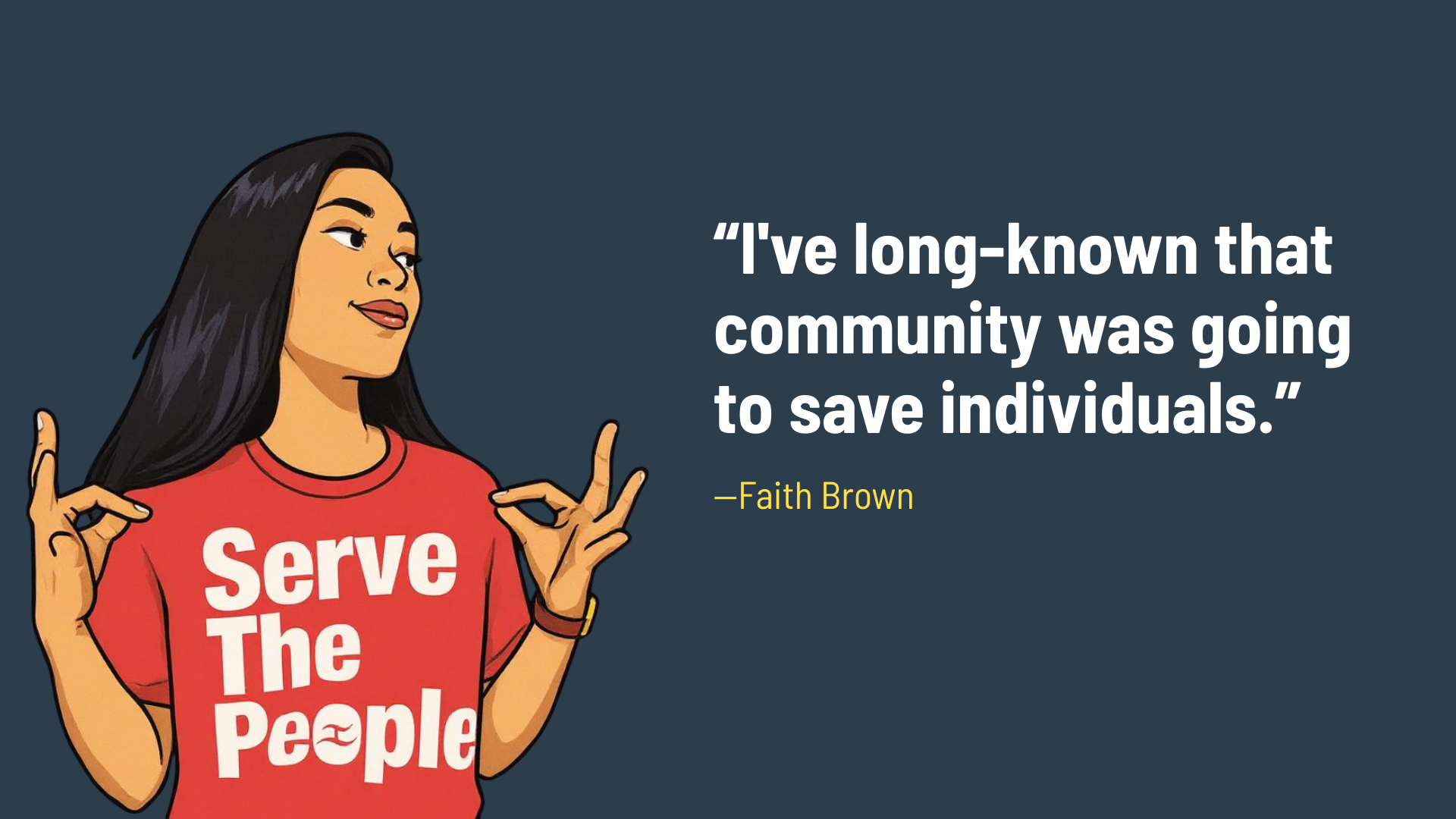
Faith: Well, I've long-known that community was going to save individuals. As an individual who didn't always have family or resources available right next to me, community has always, always been there for me. And I mean that even literally, not in a sense like, oh, there's a program tonight in a peer support group, which is also wonderful. Those are ways that community shows up. But community's shown up in really quiet, really empathetic, and compassionate ways. Kindness is what it is. It took some training to be able to recognize that, hey, kindness exists. When you see it, you see it is actually happening in a continuum, in a string, and it's really beautiful to become a part of that and be touched by that. And so I see that how I came to this work was really a calling.
I was working at a community center and working with “vulnerable at-risk youth,” as they referred to them, but to me, they were just youth who needed a safe place to go. We did really awesome programming, really great work there. Community is the lifeline for individuals, and it's the lifeline for our world. I always worked in community building capacities just through building community around myself and identifying through community and being an activist for community, as well. Just knowing that for “each one, teach one.” There's never one that's just anyone alone. There's always somebody who can connect with your experience or come alongside in allyship and support you in your experience.
I think that's one of the hardest things for folks to understand is that we're not alone. No matter how much we want to be, sometimes we can't be. We're not.
When you just think about where we could place ourselves and where we could put our best superpowers, I thought, community building. I've seen injustices and inequities across and in systems, programming, and access. I started out as an activist as a young activist, like WTO type, being part of some large youth and student-led movements that were saying some really radical things. Now I think they refer to these youth as “progressive youth,” but we were really radical. As you just kind of age in your radicalism, you got to find a career. You just get in the practice of it. And I didn't mean to, I really did not mean to be an executive director. My concern, like I said, was in the inequities and how do we keep organizations going?
Because that was something that I was seeing: these resources would be taken away from community because an agency would no longer be available or those staff were no longer available. As I was working through the industry, I already knew that finance and accounting were critical and key. The key to keeping these agencies that support community building and create community safe spaces is that they have an internal machine inside that needs to be reconciled for and accountable for, especially if you're going to be a good public steward. It's the ultimate accountability. And so my proficiencies and my background and all of my experience qualified me to work in all of these high-level management spaces, than this industry particularly.
What I also didn't realize was that my disability would come into being part of an asset for an organization. That's where I think the shift for me really had to come: recognizing that disability is actually an asset. That's something we want to talk about: I have an invisible disability despite this very visible situation.
SB: If you could clear up one misconception that people have about disabilities, what would it be?
Faith: Ableism is so strong.
SB: Speak it. Say it.
Faith: Ableism is so strong. People don't even know it exists yet. It's not even considered derogatory or rude yet to use some of the terminology or to have the things created without the inclusion or the consideration of one in four Americans.
It's so interesting to me how strong ableism is. Recently, I was in a city meeting—it's a publicly recorded meeting, so I can speak to this—and this organization was speaking to an amazing program that they had. I absolutely support this program. I want people to go to this program. But I asked this question to a board member: “When you're assessing the location and venues for your program, how do you incorporate people with disabilities into your audience or into the program to be part of the stage and the performance? How do you actually include them?” And they really had to double back on their words, because all the way up until then, they're talking about diversity and people with lived experiences. And I'm like, I love that, but what about if you have any one of these disabilities on this pride flag that I'm holding up right here? Physical disabilities, sensory disabilities, invisible disabilities, undiagnosed disabilities, social, emotional, behavioral disabilities, and then the barriers that exist for all of those disabilities. Ableism is the mainstream. We have a lot of work to do, and it's just amazing how many spaces I've been operating in and did not myself challenge that question until I came into this space.
And now, I feel like I have the responsibility to do that. Not only that, but I'm empowered to. I couldn't do that before I was here. Before I was here, my invisible disability was invisible. Nobody knew about it. It stayed invisible because it was a liability. If it's not an asset, then it's a liability. And it's because it was a liability to whatever I was doing. And what that means is that I couldn't perform my job or function in community healthily, because the bias was so strong against my invisible disability. There hadn’t been enough education about people with disabilities, in part because that ableism is still so strong.
We're in the work of deconstruction. How do we deconstruct the idea of “we're public,” “we're open,” “it's for everyone,” “it's diverse.” I'm all about diversity, because I'm on that too: being a woman, being an immigrant, being from Southeast Asian Island Nation, all of those things, being undereducated. What about my staff with disabilities? What about my community? What about me?
Bias against disabilities show up in so many different ways. It’s why I challenge the language on the record.
Slow Blink: What's a small change that made a big difference to you? Or what's one change that would make a big difference to you right now?
Faith: A small change that made a difference to me was valuing my lived experience. It would happen in small ways, in the ways communities identify themselves. But once industries got behind it, decision-making tables started to include people with lived experience. And rather than taking in testimony and reading through stacks of paper, bringing people to the table as thought partners and decision makers with lived experience. I think that's a small change, and it's huge. It's huge for people like me, who don't have a college degree, who had too many barriers in front of me to obtain my college degree. Maybe someday I'll go and get it. But for somebody like me who doesn't fit those traditional constructs of what is acceptable or what is valuable or what is even valid, eligible, creditable, legible, it really came down to community and the rhetoric of change: to value lived experience and elevate those with lived experience in any capacity, whatever that was.
It was happening in little pockets here and there, but now I'm seeing it on such a grander scale that it's a standard. Well, it's not a standard. I'm going to take that back. It's been something that we can actually speak to. Now we can connect. Now, we as humans can connect and share what our experiences are. Globalism has helped with that, too. Social media helped with that, for sure. Elevating the voices of lived experience. That little thing—lived experience being valued—is so inherent in all of us. It took the world and rhetoric to change, to elevate it, to make it a thing.
SB: So many sage words and ways of looking at words. Here's another question for you: What's a question you wish people would stop asking you?
Faith: “Are you okay?” It can be very triggering because it signifies that I need support or I need assistance when maybe I don't, or it signals that I may be struggling when I may not be. I get that question a lot. I wondered, if I was a male, would they ask me that? I had to think about that, about my male bosses. I was like, did I ever ask any of my male bosses if they were okay? I don't know. I can't think of it. Is it because we're in such a supportive, compassionate lived experience industry that this extension is the way in which we can connect?
That's why I say it's such a contentious thing. Because at the same time that it’s a question about care, it's also such a triggering question. Are you okay? Because like I said, it signals all of those things for me, just that I'm struggling or I need assistance or just can't. And there's very seldom an experience that I'm going through during the day that I can't. I can't see out my right eye right now. That's real, but I can still drive. I can still do things. I saw Spider-Man 3 earlier, and that was awesome with my one eye.
SB: What's a question you wish people would ask themselves?
Faith: “Do I have a disability?” I don't think people ask themselves that enough. It's okay, and it's okay if you do have one. And that's why I think me and my team and folks like us are trying to work on that cultural level of understanding. We're trying to celebrate community.
That's one thing that I recognize that we were missing in our community: there wasn't a safe way to identify because we weren't celebrating identity. How about we celebrate identity? Maybe we don't know how to celebrate disability identity in the household, so let's do it in a community, because community does. I've seen it. I think that's where the missing puzzle piece is actually: in the celebration.
That's where we can inform our legislators, educate our community, educate ourselves, find ourselves, find each other. And then in that, our grace has expanded. Maybe there'll be less derogatoryness towards individuals with disabilities. Just maybe.
SB: That's such a beautiful sentiment: Find ourselves in each other, and find each other in ourselves. Last question to you. How do you define independent living?
Faith: Full sovereignty over your body, your choices, your decisions, your dreams, your goals, the tools and resources you equip yourself with and decide to. When I think independence, I think sovereignty. And that is something that a lot of communities can connect on. There's a lot of us trying to be free, absolutely, and so independent living for me—having been somebody who was institutionalized and was diagnosed that I would never be independent—sovereignty was everything that got me to be where I am today.
Fighting for my sovereignty, step by step, working towards my own medical care, working towards and guiding my own medical care and my own decisions over how my body was going to be treated and taken care of during medical care. Independent living means full sovereignty for the body and the choices.
SB: Thank you for this conversation. It was a beautiful springboard into the oft-overlooked parts of living with disabilities. What a generous offering to share perspective and to share in together and to show up for each other. You offered a blueprint for how we can be closer together, so I appreciate you for the words that you shared.
Faith: I'm really excited for our community to finally know us and meet us. To just know that we're growing a lot, we're building a lot, and our goals remain the same.
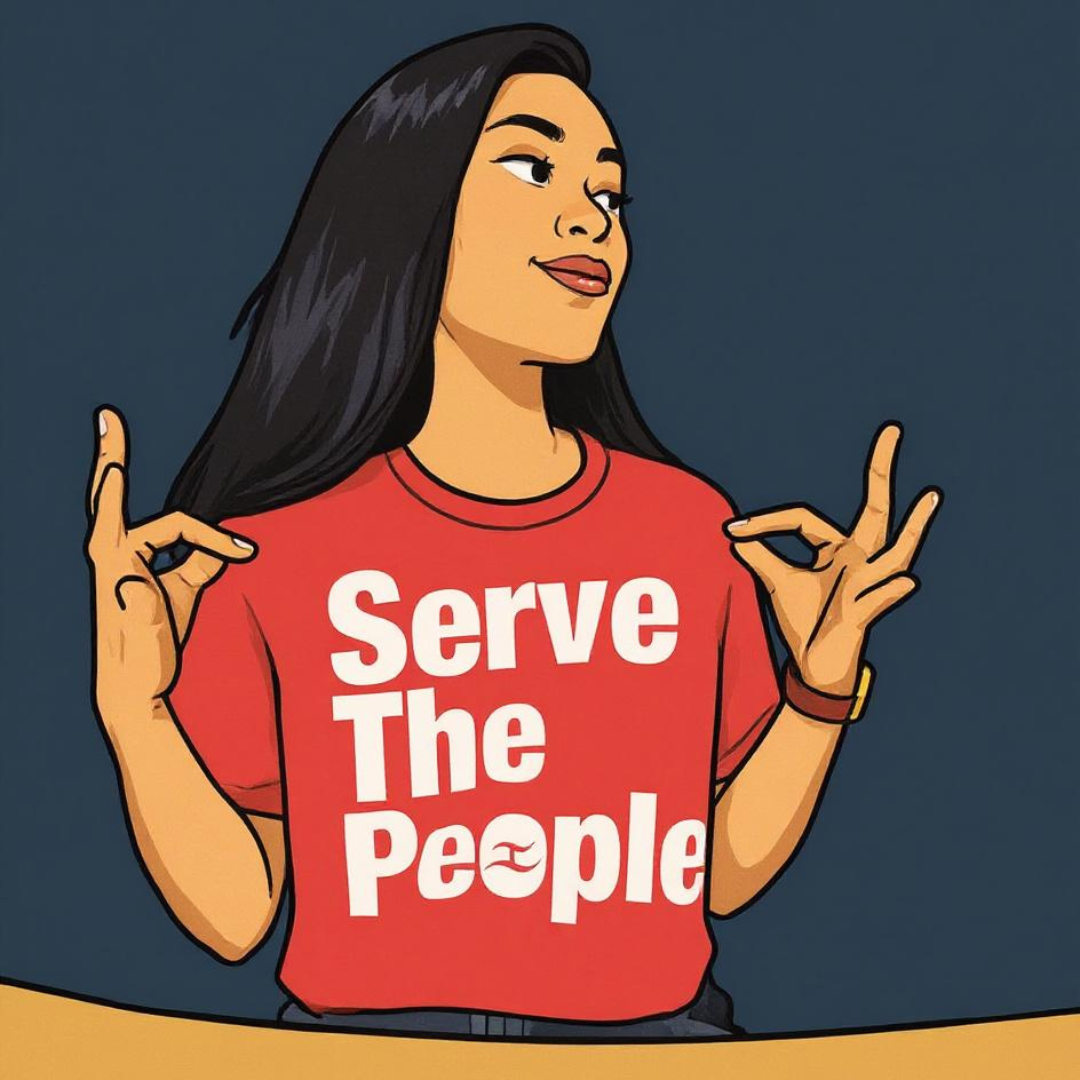
Faith Brown, Executive Director
Faith joined CFI as Executive Director in November 2024, bringing deep experience in nonprofit leadership, organizing, and organizational management, grounded in a professional background in accounting. As Executive Director, she serves as a steward of CFI’s mission, overseeing operations and financial integrity while guiding the strategic vision that drives the organization’s growth, sustainability, and impact.
Faith leads with a justice-centered approach, aligning policy, budgeting, and outcomes to advance equity across the systems CFI engages. She extends this leadership through board and community service with the Tacoma Public School Board, Washington State Historical Society, Tacoma Creates for the City of Tacoma, the Filipino American National Historical Society, Trinity Neighborhood Medical Clinic, and the Imagine Justice Project. She is a strong ally in advancing full justice and equity for LGBTQIA+, BIPOC, migrant and immigrant communities.
Faith lives in the South Sound with her husband and growing family and is a proud peer within the Independent Living Movement.